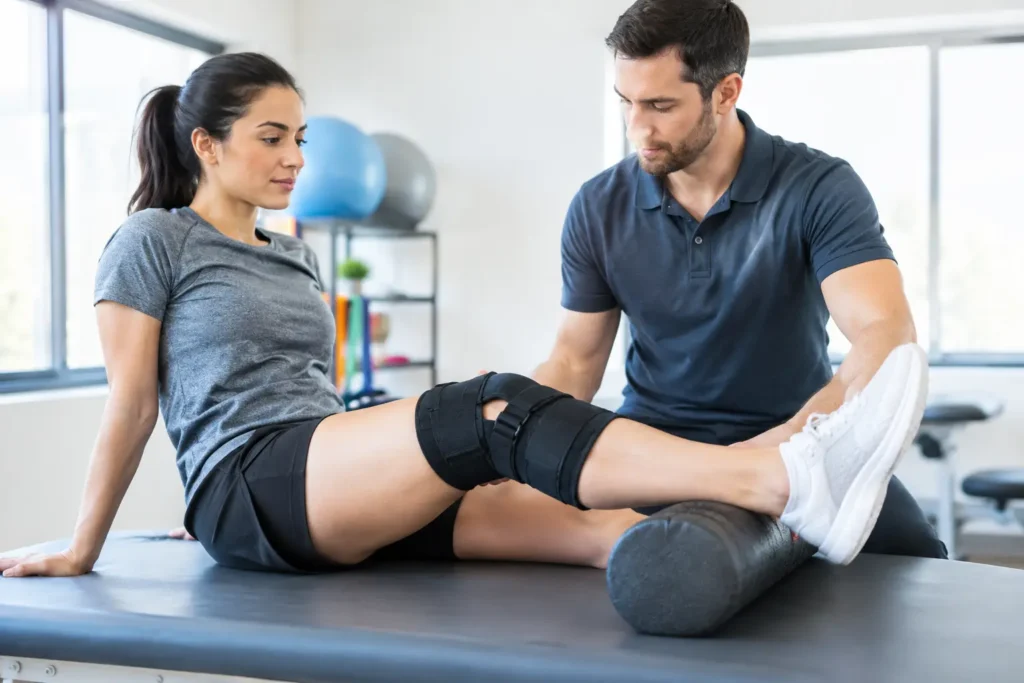
The first weeks after an ACL reconstruction can feel surprisingly demanding. Your knee may be swollen, stiff, and unreliable, while everyday tasks such as getting out of a chair, using stairs, sleeping comfortably, or walking across a room require more planning than expected. Physical therapy after ACL surgery is not simply about exercising the knee. It is a structured process of restoring movement, rebuilding strength, retraining control, and helping you return to the activities that matter in your life.
A successful recovery is rarely about rushing to a calendar date. It is about meeting the right milestones at the right time. Your surgeon, the type of graft used, any additional meniscus or cartilage repair, your pre-surgery fitness, and your goals all influence the pace of rehabilitation.
Why ACL rehabilitation needs a plan
The anterior cruciate ligament, or ACL, helps control forward movement and rotation at the knee. After surgery, the new graft needs time to heal and gradually adapt to load. At the same time, the muscles around the knee can quickly lose strength, especially the quadriceps at the front of the thigh.
This creates a difficult balance. Doing too little can lead to persistent stiffness, weakness, and an altered walking pattern. Doing too much too soon can increase swelling, aggravate pain, or place unnecessary stress on healing tissues. A physiotherapist helps you work within the productive middle ground, progressing each stage according to how your knee responds rather than relying only on how many weeks have passed.
Rehabilitation also addresses more than the knee itself. Your hip strength, ankle mobility, trunk control, balance, and confidence all affect how you walk, squat, climb stairs, and eventually land or change direction. If those areas are overlooked, the knee may continue to compensate even when pain has improved.
Physical therapy after ACL surgery: the early priorities
The first stage usually begins soon after surgery, following your surgeon’s specific instructions. The immediate goal is to protect the surgical site while preventing avoidable loss of motion and muscle control.
Settle swelling and regain knee motion
Swelling is common after ACL surgery, but it should be monitored. A knee that repeatedly becomes more swollen, warm, or painful after activity is often signaling that the current workload is too high. Your therapist may use positioning, gentle movement, manual techniques when appropriate, and activity guidance to help manage this response.
Regaining full knee extension, meaning the ability to fully straighten the knee, is especially important. Difficulty straightening the knee can affect your gait and make it harder for the quadriceps to work efficiently. Knee bending is gradually restored as well, but the target and timing may differ if you had a meniscus repair or another procedure along with the ACL reconstruction.
Restore the quadriceps connection
After surgery, the quadriceps can seem as if it has stopped listening. This is a common protective response from the nervous system, not a sign that you have failed. Early rehabilitation often includes carefully selected quad-setting exercises, straight-leg raises when control is sufficient, and weight-bearing activities that help reintroduce normal muscle activation.
The quality of movement matters. Lifting a leg with a bent knee, shifting away from the operated side, or walking with a pronounced limp can reinforce compensations. Your therapist watches these details and adjusts the exercise or support needed to help you move more evenly.
Walk safely before walking farther
Crutches and a brace, if prescribed, are temporary tools that protect your knee while you regain control. The priority is not to abandon them as quickly as possible. It is to progress toward a smooth, confident walking pattern without excessive pain, buckling, or limping.
For some people, home-based guidance or a selected in-home visit can be particularly useful during this stage. It allows rehabilitation to focus on practical challenges such as stairs, bathroom access, getting in and out of bed, and moving safely around the home.
Building strength, balance, and everyday confidence
As swelling settles and motion improves, rehabilitation becomes more active. This is where the work starts to look less like post-surgical care and more like rebuilding your capacity for daily life.
Your program may progress from supported weight shifts and controlled sit-to-stands to squats, step-ups, bridges, and resistance exercises. The exact exercise is less important than the purpose behind it: restoring the ability to load the leg with good alignment and control.
Strength work should include the quadriceps, hamstrings, calves, hips, and trunk. The hamstrings are particularly relevant because they help support knee stability, although their progression may need to be more cautious if a hamstring tendon was used for the graft. A patellar tendon graft, quadriceps tendon graft, or allograft can each bring different considerations. This is why a copied exercise plan is not a substitute for an individual assessment.
Balance and proprioception are also essential. Proprioception is your body’s ability to sense joint position and respond automatically. After an ACL injury and surgery, that system needs retraining. Controlled single-leg standing, reaching tasks, step-downs, and changes in surface or direction can help rebuild the stability needed for real-life movement.
Aqua therapy can be a valuable complement for some patients once the incision is healed and medical clearance is given. Water buoyancy reduces the load on the knee while allowing walking practice, range-of-motion work, and gradual strengthening. It is not a replacement for land-based rehabilitation, especially when return to running or sport is a goal, but it can make early movement feel more manageable when pain, fear, or weakness is limiting progress.
Returning to work, running, and sport
Returning to normal activity is not one single milestone. An office-based professional may be ready to work before they are comfortable commuting, taking stairs, or sitting with the knee bent for long periods. A parent may need to lift a child or manage a busy home. An athlete may feel fine jogging straight ahead but still lack the control needed to cut, pivot, decelerate, or land safely.
Running is usually introduced only after you have adequate motion, minimal swelling, a stable walking pattern, and sufficient lower-limb strength and control. It depends on the procedure and your recovery, but running too early can reinforce poor mechanics rather than build readiness.
Return to pivoting sports requires a higher standard. Rehabilitation needs to include progressive hopping, landing, acceleration, deceleration, direction changes, and sport-specific drills. Your therapist may use strength and functional testing to compare sides, but no single test can guarantee safety. A return-to-sport decision should consider knee function, movement quality, psychological readiness, your surgeon’s guidance, and the demands of your specific activity.
Signs your program may need adjustment
Some discomfort and muscle fatigue are expected as you become more active. Persistent worsening pain, a major increase in swelling, new calf pain, fever, wound drainage, or a feeling that the knee is giving way should be discussed promptly with your surgical team.
Less urgent signs also deserve attention. If your knee remains stiff, you cannot fully straighten it, you still limp, or your exercises regularly cause a prolonged flare-up, your plan may need to be adjusted. Recovery is not always linear. A thoughtful change in load is often more helpful than pushing through or stopping everything.
The value of guided, function-first recovery
The goal of ACL rehabilitation is not merely to complete a list of exercises. It is to help you trust your leg again when you stand from a chair, walk on uneven ground, return to work, play with your children, exercise, or compete in sport.
At PhysioRebound, rehabilitation is built around those practical outcomes. Your plan should make sense to you: what you are working on, why it matters, and what the next step requires. With consistent guidance and progressive loading, the knee can move from feeling protected and uncertain to feeling capable again. Give recovery the time, attention, and skilled support it deserves – then let each regained movement become evidence that you are ready for more.